Guides / Materials
PLA vs PETG: which filament should you use?
PLA and PETG are the two filaments most people print with every day. Here is how they differ, which one suits your part, and what to change when you switch.
PLA and PETG cover most of what hobbyists and small print farms make. Both print on almost any open-frame printer without an enclosure, both are widely available and both are forgiving once your machine is set up. They do behave differently, though, in the printer and in use. This guide explains where each one shines, how to pick for a given part, and what to change in your slicer when you swap spools.
The short answer
If you are unsure, start with PLA. It is the easiest filament to print well, it holds fine detail and it gives crisp overhangs and bridges.
Reach for PETG when the part has a job to do outdoors, in heat, or under repeated stress. It is tougher and less brittle, and it keeps its shape at higher temperatures than PLA.
Neither is wrong for a first try. The best choice depends on where the part will live and what it has to put up with.
Where PLA wins
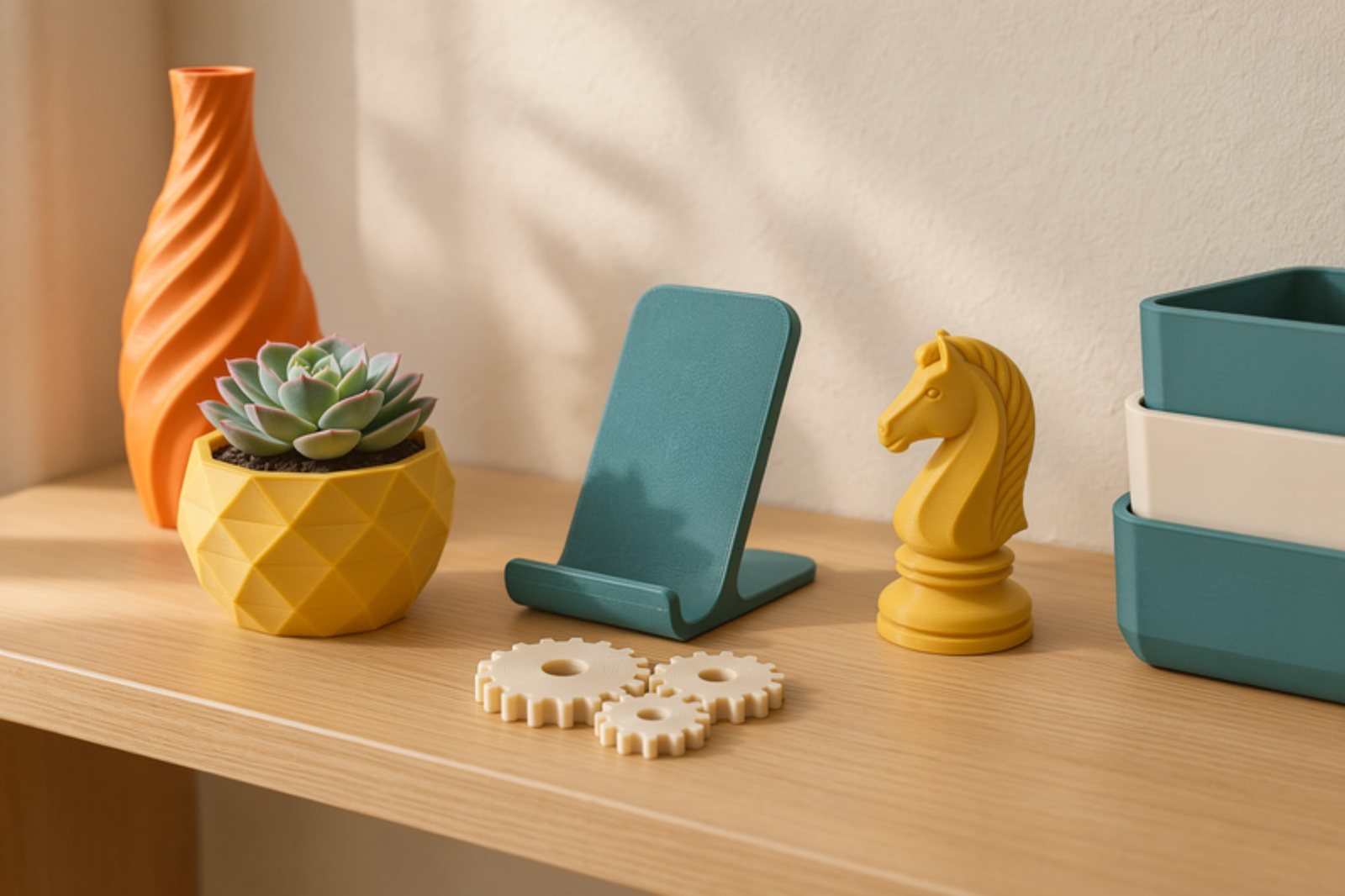
PLA is stiff and dimensionally accurate. Parts come off the bed looking sharp, with clean edges and little warping, which makes it ideal for display models, cosplay pieces, jigs that sit on a bench, and test prints while you tune a new design.
It also prints fast with full part cooling, sands and paints well, and is the least fussy about bed adhesion. Most printers ship with PLA profiles that work out of the box.
The weak points are heat and impact. PLA starts to soften at around 55 to 60 °C, so a part left in a parked car or near a heater can sag or creep. It is also brittle: it tends to snap rather than bend, which matters for clips, hinges and anything that gets dropped.
Where PETG wins
PETG is tougher and a little flexible. A PETG clip bends where a PLA one would crack, and layers usually bond more strongly, so parts are less likely to split along the layer lines.
It handles heat better, typically holding its shape up to roughly 70 to 80 °C, and copes with outdoor use and moisture far better than PLA. That makes it a good fit for brackets, enclosures, garden fittings, tool holders and mechanical parts.
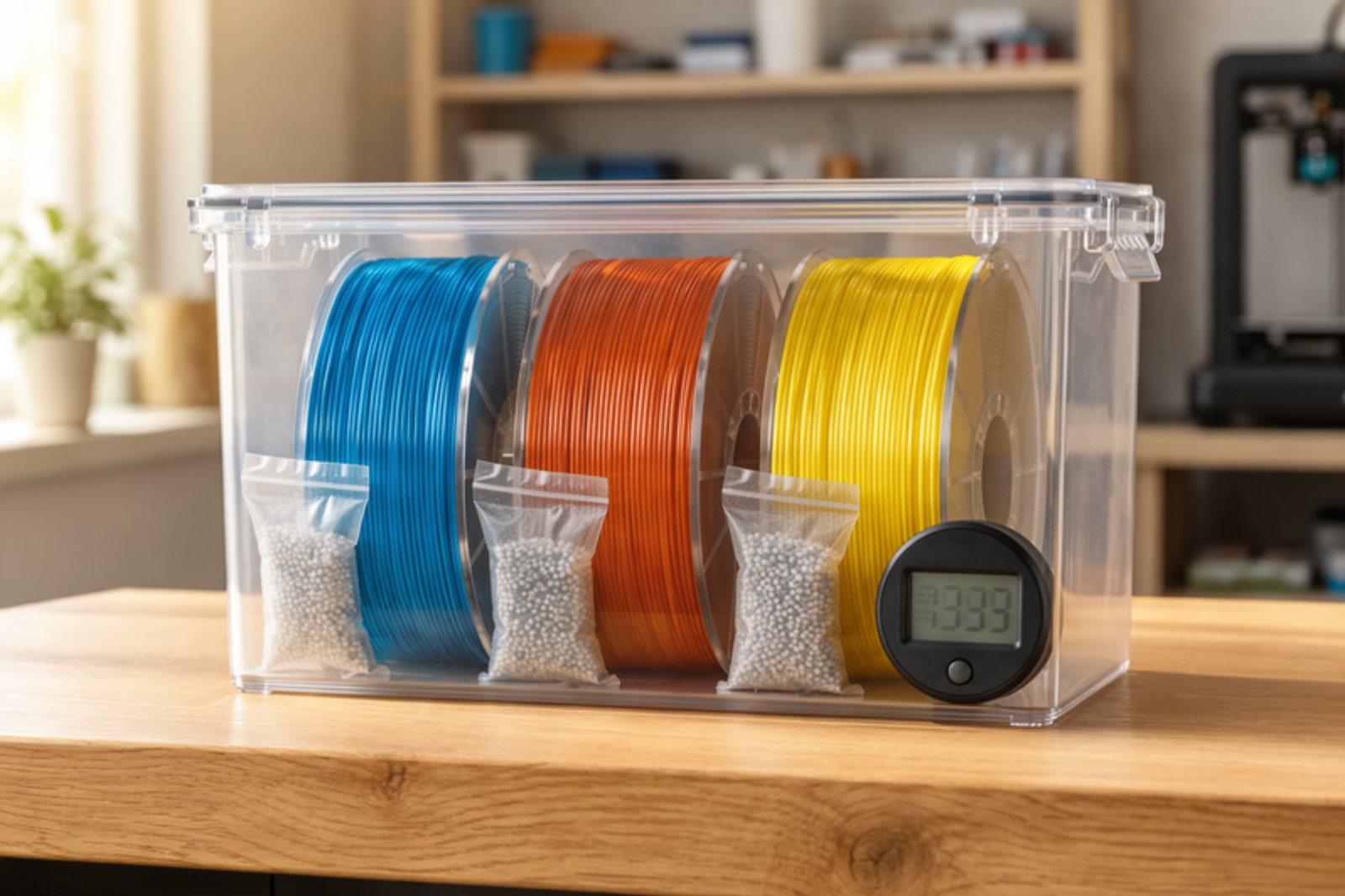
The trade-offs are in printing. PETG strings more easily, its overhangs and bridges are softer, and fine detail is less crisp. It can also bond too well to a smooth PEI or glass bed and pull chunks out when you remove the part. It picks up moisture faster than PLA, which shows up as popping, extra stringing and rough surfaces, so keep it dry.
What to change when you switch
Your PLA profile will not print PETG well. Start from your filament maker's recommended ranges, then work through these changes in order and run a small test print before committing to a long job.
- Raise the nozzle temperature to the PETG range, usually 230 to 250 °C, and print a temperature tower to find the sweet spot for that spool.
- Raise the bed to around 70 to 85 °C and wipe it clean with isopropyl alcohol.
- On smooth PEI or glass, add a thin layer of glue stick as a release agent; textured PEI often needs nothing.
- Increase the first-layer Z offset slightly so the nozzle does not squash PETG into the bed, which causes blobs and nozzle build-up.
- Cut part cooling to roughly 30 to 60 percent, using more only for overhangs and bridges.
- Slow down: many profiles drop PETG outer walls to about 60 to 80 percent of the PLA speed.
- Tune retraction for stringing, then reprint your test.
| Setting or property | PLA (typical) | PETG (typical) |
|---|---|---|
| Nozzle temperature | 190 to 220 °C | 230 to 250 °C |
| Bed temperature | 50 to 65 °C | 70 to 85 °C |
| Part cooling fan | 80 to 100 percent | 30 to 60 percent |
| Softening point | about 55 to 60 °C | about 70 to 80 °C |
| Impact behaviour | Stiff, snaps | Tough, bends |
| Bed release on smooth PEI | Usually easy | Use glue stick |
| Moisture sensitivity | Moderate | Higher |
Choosing for a specific part
Ask three questions: how hot will it get, will it bend or take impacts, and does it need fine detail? The answers usually point to one filament.
- Desk models, figures and prototypes: PLA.
- Parts that live in a car, a shed or direct sun: PETG.
- Snap fits, clips and living hinges: PETG.
- Tight-tolerance fixtures used indoors: PLA, for its stiffness and accuracy.
- Waterproof or outdoor housings: PETG, printed with extra walls.
- Parts near motors, hotends or anything above about 80 °C: neither; consider ASA or ABS in an enclosure, with proper ventilation, as both give off fumes while printing.
Pick the filament for where the part will live, not for what is already loaded in the printer.
Running both side by side
Many people keep both on hand, PLA for everyday prints and PETG for functional ones. Save a separate, clearly named slicer profile for each so you never send a PETG job with PLA settings.
When you change filament, purge until the new colour and material flow cleanly, since leftover PLA in a hot PETG nozzle can char. As with any print, stay within reach of the printer for the first layers and follow the usual precautions such as a working smoke alarm and firmware thermal protection.
If you run more than one printer, SpoolBoss can help you keep both materials organised: it tracks each spool with grams left and price paid, so you can see what you have before you queue a job and what each print really costs.
Common questions
Is PETG stronger than PLA?
It depends on what you mean by strong. PLA is stiffer and can carry more load before it bends, but it snaps suddenly. PETG flexes more and absorbs impacts, so it survives drops and repeated bending far better.
Can I print PETG without an enclosure?
Yes. PETG prints well on open-frame printers because it warps much less than ABS or ASA. Keep draughts away from the printer and use a heated bed in the range your filament maker recommends.
Are PLA or PETG prints food safe?
Not reliably. The raw material may be rated for food contact, but layer lines trap bacteria and the nozzle, colourants and additives may not be food safe. Treat printed parts as unsuitable for repeated food contact unless the whole process is certified.